
YOUR COMPLETE GUIDE TO KITCHEN KNIVES
Whether you’re a professional chef or a modest home cook, having the right knife for the right job in your arsenal is generally advised as the first step towards masterful cookery. But how do you know where to start? With so many styles, brands, shapes and sizes available, choosing the right knife for you can become somewhat of an overwhelming task.
Well fear not, aspiring chefs, we are here to help you. The following how-to guide has been designed to arm you with all the knowledge you will need to confidently select, use, care for and sharpen your chef knives; skills that will no doubt see you and your shiny kitchen sidekick sharing many good times over the cutting board, well into the future.
shop all chef knives nowSo, first things first. Let’s go shopping.
 Which Knife is Right for You?
 Wield it Like a Pro
 Give it Some Love
 Stay Sharp
 Bring it Back to Basics
 Know Your Knives

Getting the Right Knife
When it comes to great cooking, not just any old chef knife will do – you want something durable, something strong, something that handles well. Sure, you could just go out and spend all your hard-earned coin on the best brand on the market, but brand alone won’t guarantee the best choice for you – it’s more about quality. That said, everyone is different, and your knife should be a reflection of this. You’re going to be spending a lot of time together, so effectively your knife should be an extension of you.
But before hitting the shops, it’s a good idea to do as much research as possible and to think not only about your budget, but also about what purpose your new knife will serve. Will you be slicing, dicing, peeling or chopping? Do you want something that can do it all? With so many different styles available, it’s pretty hard to know where to start. Generally speaking, a home cook won’t have use for anywhere near as many knives as a professional chef, but that doesn’t mean you can’t or shouldn’t have it all. When starting a kitchen knife collection, there are some basics you’ll definitely want to invest in, such as:
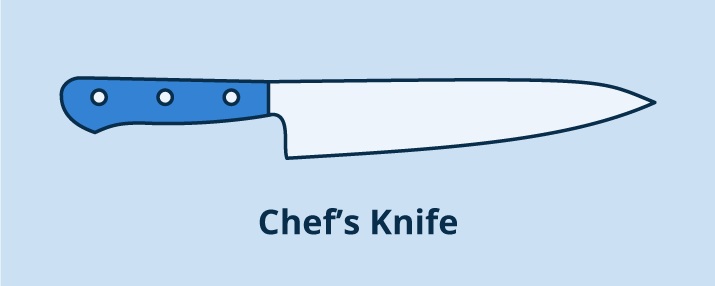
Chef’s knife: By far the most versatile and popular of kitchen knives, used for chopping, dicing, slicing and mincing. The perfect all-rounder. Chef's knives range in size from 15cm to 30cm (6” to 12”), with 20cm (8”) being the most common size.
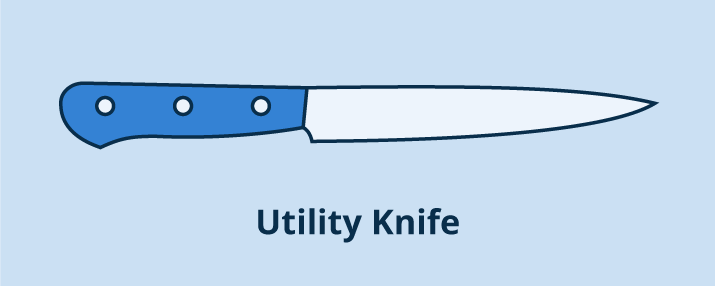
Utility knife: A versatile knife for everyday tasks, though not quite as versatile as the chef’s knife given its shorter length. Can be used for slicing meats or chopping smaller vegetables. Utility knives range from 10cm to 18cm (4” to 7”) in length.

Peeling/Paring knife: The small-but-mighty paring knife can be used for precision tasks such as peeling, trimming and coring vegetables and fruits. Paring knives are usually between 6cm and 10cm (2½” to 4”) long.
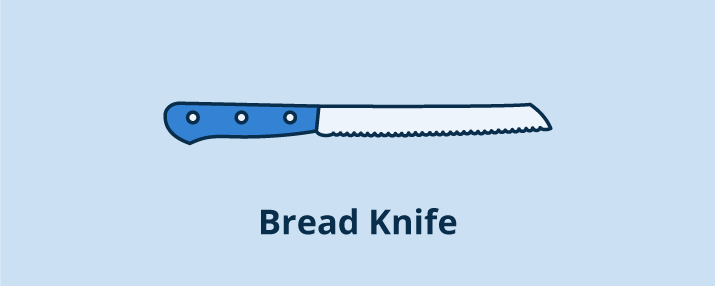
Bread knife: You guessed it, this knife’s serrated edge is perfect for slicing through fresh bread or cakes without squashing. Also good for slicing soft fruits, such as tomatoes, without bruising the delicate flesh. Bread knives range between 15cm and 25cm (6” to 10”).

Tomato knife: Just as the name implies, a tomato knife is a small serrated kitchen knife designed to slice through tomatoes. The serrated edge allows you to slice through the tomato skin easily with a minimum of pressure so as not to crush the flesh.

Cheese Knife: As there are many varieties of cheese, you’ll also find there are different varieties of cheese knives, most commonly sorted into hard cheese knives, and soft cheese knives. Soft cheese knives are sharp, often serrated and feature cut-outs in the blade to prevent cheese from sticking. Hard cheese knives are much heavier and more sturdy, often shaped like a mini cleaver.
Then, once you’ve mastered the basics, you may wish to further hone your skills with a few new additions:

Cleaver: A solid, heavyweight cleaver is the perfect tool for chopping through meat and poultry bones, and is sure to have you feeling just like a contestant on Iron Chef. Cleavers for home use are typically around 15cm (6”) long.

Filleting knife: With its thin, flexible blade, this knife is used to easily fillet fish, remove small bones and skin. Filleting knives range from 15cm to 28cm (6” to 11”).
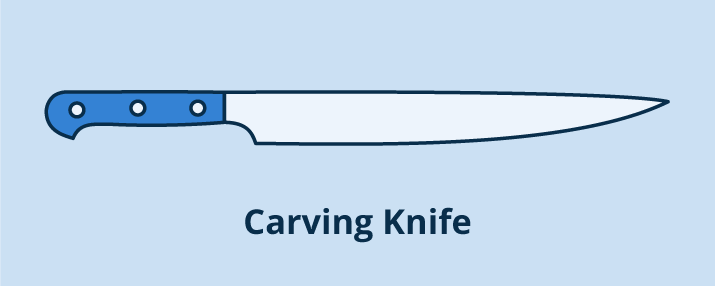
Carving knife: You’ll need this one for your Sunday roast. Featuring a long thin blade, the carving knife is perfect for slicing thin cuts of meat, and ranges in size from 20cm to 38cm (8” and 15”).

Boning Knife: Featuring a sharp point and narrow blade, boning knives are used for removing the bones from poultry, meat, and fish. They typically range in size from 12cm to 17cm (5” to 6½”).

Palette Knife: A popular knife loved by pastry chefs, this knife is similar to a spatula and has a blunt round end used for spreading toppings, such as icing on a cake. It does not have a sharp edge, and therefore cannot be used for slicing or cutting.
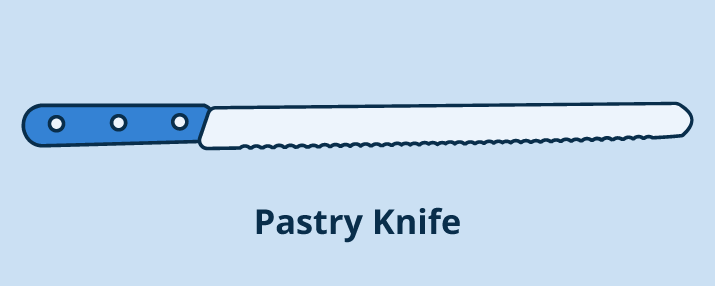
Pastry Knife: Once you’ve iced your cake, you’ll want to cut yourself a slice. And that’s exactly what your pastry knife is for, with its long serrated blade. Pastry knives are generally around 25.5cm (10”) in length.
Now, Don't Freak Out...
Obviously purchasing this many chef knives can become expensive, which is why most experts will advise you to start your collection with a solid utility or chef’s knife for basic day-to-day cookery, plus a quality serrated knife for bread, cakes and tricky fruits – such as tomatoes. Because let’s face it, nobody wants to eat your squashed tomato. Anything outside of that, such as a cleaver or filleting knife, may only become necessary as your skills become more advanced, or if you feel like impressing your friends by getting fancy with a whole fish.
By now you should have an idea what type of knives you need. So it’s time to go shopping. If your budget is causing you grief, then a pre-packaged kitchen knife set could be the way to go, however, the downside to this option (despite being cheaper) is that you may not enjoy the feel of each individual knife in your hand, and could therefore end up wasting money on knives you simply have no use for.
If budget permits, it’s recommended that you shop for knives individually, where you have the opportunity to hold each one to test the weight and balance. The knife should feel comfortable in your hand – a feeling that won’t be the same for everyone as it is a completely personal preference. When you’re holding it, remember to assess the weight of the knife against the task you expect to use it for. For instance, if it’s speedy precision chopping you’re after, ensure the knife feels lightweight enough for the job, but still sturdy in your hand.

What is Your Knife Made of?
Think you’ve made your choice? Great! But don’t get your wallet out just yet. Instead, consider what your knife is made of. Generally speaking, the best blades are made from high-carbon stainless steel, though these can be very expensive and are not always within reach for those of us on a budget. Ceramic knives are also professional quality, but can break easily if not maintained properly and also tend to come at a high price.
As a general rule of thumb, you can’t go wrong with a good mid-range stainless steel kitchen knife, though be wary of any knife claiming it won't ever need sharpening – these blades are not particularly durable, and cannot be sharpened once dull. Which might be fine for the short term, but not the best choice if you’re looking to make a long term investment. That's why you should invest in a decent knife sharpener to maintain your knife's sharp blade.
Blades aside, let’s talk handles. The best knives are made from all steel, as opposed to those with a cheap plastic handle which can eventually become brittle and snap. Wooden handles may also pose a problem down the track, as the wood tends to deteriorate over time. If you do choose a knife with a plastic or wooden handle, ensure that the hilt (where the handle meets the blade) is well joined with no gaps as to avoid breakage and prevent bacteria growth.
So, Which Brand is Best?
In a market showcasing literally hundreds of brands, it’s hard to be sure that the kitchen knife you choose is the best quality product for your budget. Price can be a good starting point of course, but more expensive doesn’t necessarily mean better quality, so it’s a good idea to do some research before you hit the shops.
To help you out, we've interviewed 100 chefs on their knife preferences, and these were the results.

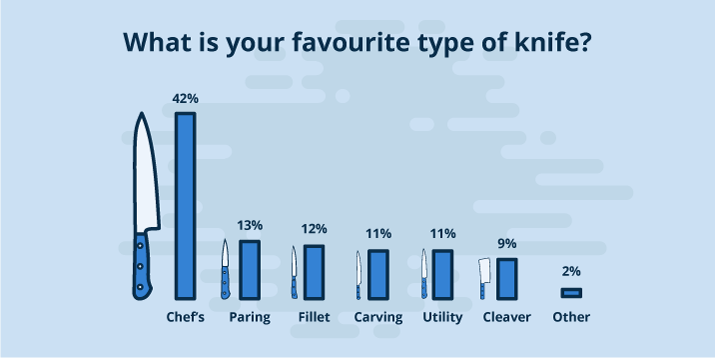

Our Favourites
We've also compiled the below list of our favourite Top 6 kitchen knife brands:
- Hygiplas Knives: With a comprehensive range of contamination-preventing colour-coded knives, Hygiplas caters for both amateurs and professionals alike, providing the perfect balance of quality and value for customers. Blades are crafted from the finest stainless steel, and handles are dishwasher safe.
- Victorinox Knives: Originally known for their high quality pocket knives, Swiss brand Victorinox also produce a very high quality selection of professional chef knives, featuring nylon and rosewood handles across the range.
- Dick Knives: This German brand has a long-standing reputation for producing high quality, ergonomic knives for chefs around the globe. Dick combines new technology with traditional techniques to craft knives that are comfortable in the hand, as well as razor sharp.
- Tsuki Knives: If you’re after something high-end, then look no further. Crafted from the same steel as a Samurai sword, Tsuki knives feature a distinctive and stylish ‘grain’, and the black micarta handles – made from a composite of fabric and resin – not only provide excellent grip, but also help to prevent contamination.
- Vogue Knives: This leading brand delivers a range of affordable high-quality blades made from premium German stainless steel, designed to cover all of your kitchen needs with comfort and style in mind.
- Global Knives: Crafted completely from stainless steel with weight and balance in mind, Global is one of the world’s most well known kitchen knife brands, offering a huge range to choose from. The seamless construction is not only a design feature, but also a means of preventing contamination.
TIP: See our Infographic on Knowing Your Knives.

Ok, so by now we’ve all seen Masterchef and marvelled at Marco Pierre White chopping onions with wizard-like precision and speed, and we all know that it’s best to avoid chopping off one’s own fingers. But how exactly do we attain this level of skill, without a professional qualification or years of training? With a little practice, patience and persistence, that’s how. And sometimes with the help of a few YouTube videos…
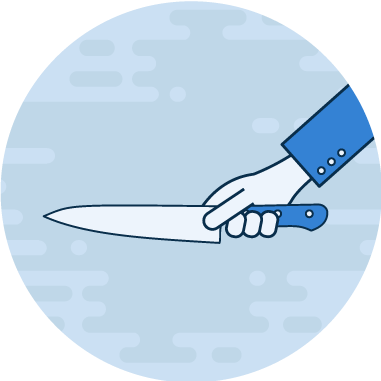
The first step is learning to hold your knife correctly. Think of the knife as your friend, and try holding it as if you were going to shake hands with the handle – with your index finger on the flat side of the blade and your remaining fingers firmly gripping the handle, just below the blade. This is by far the safest and most accurate way to achieve nice precise cuts because your fingers are close to the blade so you have maximum control over it’s movement.
You certainly don’t want to be running around with all four fingers intensely gripping the handle like some ill-fated character in bad teen horror movie. Keep your elbows in, your sleeves rolled up and the knife parallel to your body.
Once you’ve got hold of the knife, be sure to always keep the tip and blade pointed down. Your knife should be razor sharp at all times, and you don’t want to mess with that. Safety first friends.
Now your free hand can be used to guide and grip the food, which is best done using using a claw-like grip. Keep your fingers curled inward and grip the food with your fingernails to keep your fingertips out of harm's way. The side of the knife blade should then rest gently against the first knuckle of your hand to keep the blade upright as you chop, slice and dice.

By mastering these basics, you’ll be well on your way to a whole new level of culinary happiness.
A Few Extra Tips
Keeping a few extra key tips in mind won’t hurt either, such as:
- Keep your knives sharp, as dull knives can easily slip and you’re actually more likely to be extra careful when dealing with a sharper blade (more on this later).
- Ensure you slice away from your hand and keep your fingers clear of the blade.
- Avoid holding food in your hand when cutting – you can easily slip and cut your palm.
- When dicing or mincing, keep the tip of your knife in contact with the cutting board and move the handle up and down quickly, making sure to keep your fingers well out of the way.
- Secure your cutting board on your bench using rubber feet or a damp tea towel so it doesn’t move around while you work.
- Choose the right knife for the right job. For example, avoid hacking away at a block of hard cheese with a flimsy steak knife.

Look After Your Knife

Once you’ve invested in a decent knife, you’ll want to protect that investment by looking after it properly. You might think this sounds obvious, but many people make lots of little mistakes that can drastically reduce the lifespan of their most important kitchen instrument. Sometimes people even think they are safer working with a dull knife, which is not the case. A sharp knife provides for better efficiency and more precise cutting, and believe it or not, if you do accidently slip and cut yourself a cut from a sharp knife will actually hurt less than one inflicted by a dull knife. It will heal faster too.

So, tip number one for protecting your knife: never put it through the dishwasher. Most detergents used in household dishwashers are highly abrasive and over time can begin to wear down the blade of your knife. Another issue with dishwashers can be the agitation against other utensils during the wash cycle, which again can cause bluntness. Also, if your knife handle is made from plastic or wood, the harsh wash cycle can cause irreparable damage by weakening or loosening joins. The best way to clean your knife is in a kitchen sink full of hot soapy water, followed by immediately drying and storing appropriately.

TIP: Never leave your knives in the sink waiting to be washed – the blade can get scratched, chipped,or worse, the tip could bend or break. And of course, you could cut yourself trying to retrieve it from the water.

Sharpening and Honing Your Knife
To sharpen or to hone, that is the question. Honing, unlike sharpening, is sort of like the dental floss of the knife world; a preventative measure used to keep your knife in tip top shape in between sharpening sessions. By honing your knife regularly (preferably each time you use it), you can buy yourself a lot of extra time before you need to actually sharpen it.
Learning to hone your kitchen knife is an essential skill if you want to prolong the sharpness of your knife, and to avoid having to sharpen them more than is absolutely necessary. Because actually, sharpening can be quite destructive to your knife. What happens every time you you sharpen, is a little of the metal on the blade blade is ground away, meaning it’s gone forever, never to be seen again. So the less you sharpen the longer you will be able to maintain your knife’s original condition. Basically, honing more equals sharpening less.
Honing your knife is relatively simple, can be done at home, and takes hardly any time at all. Here’s what you do:
- Take the knife steel (a fine grit ceramic one is best) in one hand, ensuring it is pointing down and away from you, or even standing upright. Rest the tip of the steel on a non-slip surface such as a tea towel or cutting board to ensure it doesn’t move around.
- Position the heel of the knife (the end closest to the handle) flush against the knife steel, with the tip pointing out at roughly a 20-degree angle. If you’re unsure, try creating a 90-degree right angle, then rotate the back of the blade so the knife halves the imaginary 90-degree angle. Then halve that angle again and you’ve got 22.5 degrees. You can leave it there, or adjust it a tiny bit more for 20 degrees.
- Next, slowly glide the knife down, applying a steady gentle pressure (being careful not to press too hard), making sure you maintain the 20-degree angle as you carefully slide the blade down the steel from the heel to the tip. When you have completed the motion the entire length of the knife blade (on one side) should have made contact with the steel.
- Then, simply repeat this step on each side of the knife’s edge. Repeat 2-3 times on each side, then check the blade. If you feel it needs another few rounds, go for it. Anything up to 8-10 times on each side should do the trick, so be careful not to overdo it.
- Once you’ve finished honing, wipe down the blade with a clean tea towel. Now you’re ready to get cooking!

If you’ve followed the above steps but find you aren’t achieving the results you expected after say, 5 or 6 passes, it could be that you’re not holding the knife at the correct angle, or that your knife simply needs to be sharpened and no amount of honing is going to bring it back. You can always jump onto YouTube if you’re unsure of how the motion should be carried out – there are literally thousands of videos online demonstrating correct honing techniques.
This brings us to sharpening. If you’ve been following all of the advice regarding caring for your kitchen knives, you should find you only need to have them sharpened around once every year. Maybe twice. Having a sharp knife is imperative for good cooking, as hacking away at ingredients with a dull blade can easily damage them and alter the flavour.
There are a range of tools available to buy if you’re brave enough to give sharpening at home a try, such as Japanese waterstones and pull-through sharpeners, though be mindful that using these can sometimes do more damage than good, particularly with the pull-through variety as these tend to take a one-size-fits-all approach and won’t work with more delicate blades, such as those found on Japanese knives.
For optimal results, your best bet is to seek out a professional knife sharpening service. Professional sharpening is fairly inexpensive, typically ranging between $10 - $20 AUD (depending on where you go), and almost always guarantees the best result. A quick search online should reveal your nearest knife sharpening service, or often the local butcher will be able to point you in the right direction, or even do it for you.
Stamped

Let's Recap
After all this reading you should now be feeling pretty confident about choosing and caring for kitchen knives. But let’s just recap some of the key points before we send you on your way:
- Choose a knife that suits you, not someone else. It should feel comfortable and sturdy in your hand – not too heavy, not too light.
- Choose the right knife for the right task – no point using a cleaver on soft fruit, right?
- Wash knives in hot soapy water, dry immediately and store appropriately so the blades don’t get damaged.
- Hone, hone, hone! Learning to hone correctly will keep your knife sharper for longer.
- Sharpen once, or maybe twice a year. Professional sharpening services are the best option.
So there you have it! By keeping all these tips and tricks in mind, you can not only extend the lifespan of your knife, but also impress your friends and family with your newfound skills and prowess in the kitchen. And isn’t that what it’s really all about? Cooking incredible food with flair and finesse, sharing it with the ones you love, then bragging about it later on Instagram.
Types of Knives
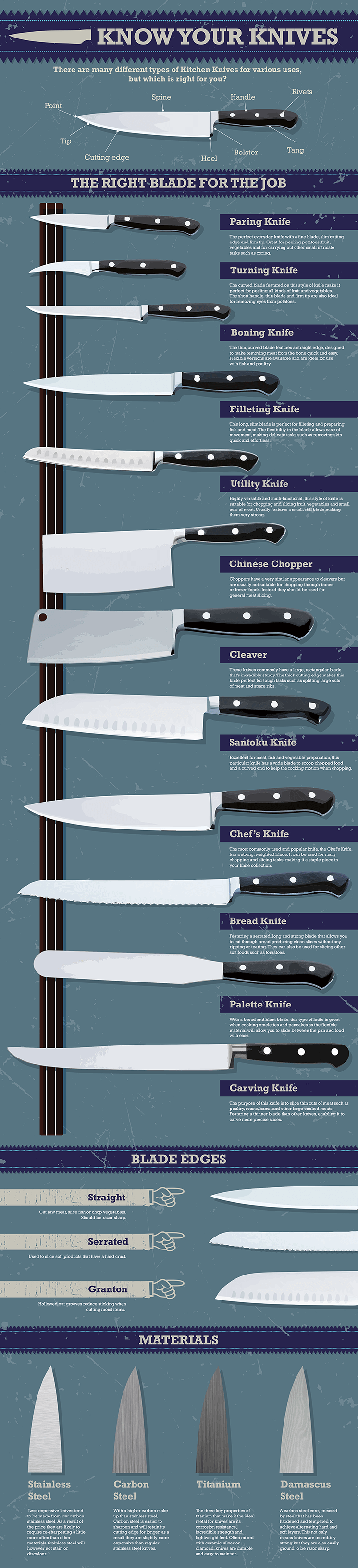
There's no one type fits all when it comes to kitchen knives. Yes, a chef knife can see you through the majority of preparation tasks. But if you want to carry out a specialist task, such as filleting a fish, then you'll need a specific knife to carry out that task well.
From boning and turning knives to choppers and santoku knives, our detailed infographic below guides you through each knife type and their uses. And having a varied collection of these knives makes it easier for you to prepare a varied menu.
FAQs
What is the best way to sharpen knives?
Knife sharpening steels or whetstones are both effective tools for sharpening chef knives. A traditional steel is best suited for regularly honing knives. If you're restoring blunt knives, a diamond steel has a tougher and more abrasive surface.
What are the best kitchen knives?
It depends on what task you need it for. Chef knives are the most versatile type of kitchen knife for chopping, dicing and slicing. Utility or paring knives are shorter for more precise tasks, while specialist knives are available for chopping food such as bread, cheese, tomatoes and meat.
How should you store kitchen knives?
It is important to keep your kitchen knives safe between uses. A knife block is a practical and efficient item for storing your collection. Storage wallets and cases are both popular alternatives. Some knives also come with their own protective guard.
What are kitchen knives made of?
Stainless steel blades are the most popular for kitchen knives. A mid-range stainless steel is good enough for most general uses. The best blades are made from high-carbon stainless steel, but these are more expensive. Ceramic knives also perform professionally, but these can break easily if not maintained properly.