Picking a Commercial Oven
Your commercial oven is one of the most important pieces of commercial kitchen equipment. It doesn't matter whether you own an independent restaurant or a chain of large eateries, the chances are your oven gets used for most of the hours in the day. This guide is designed to help you find the right oven for your business.
OVEN RANGE

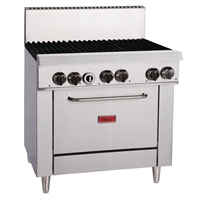
The oven range is one of the most common models of oven. It features a large internal oven capable of holding various sized gastronorms for cooking meats, pastries or desserts, as well as heavy duty open gas burners. You'll find that some of our gas oven range is made up of models that feature a full-size built-in griddle or half open burners and half griddle plate, giving you the flexibility to cook a whole range of foods.
- Space Saving: prevents buying two or more separate appliances and running them all at the same time
- GN Compatible: many oven ranges are gastronorm compatible, allowing quick transfer of pans between appliances
- Flexible: dual functionality of oven and hob cooking allows multiple dishes to be cooked simultaneously
CONVECTION OVEN

A convection oven, also called a fan oven, is made with an internal fan that distributes heat throughout the oven. This method of cooking reduces meat shrinkage and cooking times meaning you get more for your money.
These cookers are ideal for traditional bakeries, restaurants and even event catering as some of the most efficient versions can run from a single 13A plug.
- Better Yield: reduced cooking times mean meats retain more of their weight
- Even Cooking: a consistent temperature throughout the oven ensures food cooks the same regardless of which shelf its on
- GN Compatible: many convection oven are gastronorm compatible, allowing quick transfer of pans between appliances
- Better Browning: the improved air distribution helps to render fat and brown food better than static ovens
- Fast: fan heat distribution reduces cooking times by around 25%
CONVEYOR OVEN

When it comes to high volume consistent cooking, a conveyor oven is an excellent choice. Commonly used in takeaways or food halls, these quickly cook foods such as pizza, burritos, pies and more by using a set of rollers to slowly pull food past the powerful cooking elements.
Almost anything that can be cooked in a standard oven can be cooked in a conveyor oven, although it has to fit in a small 3-5” opening. As well as conveyor ovens, pizzas are commonly cooked in the more traditional stone base “deck” ovens for the perfect thin or stuffed crust pizza.
- Consistent: as the conveyor speed stays consistent, pies and pizza are cooked the same every time - great for multi-site businesses
- Easy to Use: once the oven is on, all the user needs to do is place the food onto the conveyor - no buttons to push or costly training required
- Stackable: both deck and conveyor ovens are usually stackable to double or even triple output
Combination Oven

More commonly called combi ovens or combi steamers, these are generally the most advanced and powerful cooking appliances in the professional kitchen. Combi ovens cook using steam, convection or a combination of both. This means they can do the job of multiple other cooker types in one single appliance, removing the need to transfer pans between appliances and therefore saving time and energy.
As combination ovens cook with and generate a lot of steam, most models will need to be connected to a mains water supply. In addition, sufficient overhead extraction will be required in many circumstances. As such, when buying a combi oven, an engineer may visit your kitchen before installation to check whether the oven will work effectively. This process is called a site survey.
- Very Flexible: capable of steaming, frying, roasting, baking, stewing, braising and more
- Space Saving : as everything can be done in a single machine, you may not need other bulky appliances
- Manual or Programmable: either control the combi yourself, or push a single button for complex multi-stage cooking - the choice is yours. Modern programmable versions usually have intuitive touch screen control and Wi-Fi connectivity
- Better Browning: exactly the same as convection ovens, combi ovens distribute air to render fat and brown food better than static ovens
- Precise: create dishes just how you want. Even manual versions are designed for accurate temperature control
- Size: combination ovens are available in a range of sizes, from small countertop versions all the way up to large roll-in versions
HIGH SPEED OVENS

As the name suggests, high speed ovens are built for ultra-fast cooking. Able to cook up to 20 times quicker than traditional ovens, these are best placed in fast-paced "while-you-wait" businesses. By combining multiple different cooking methods, these ensure you get the results you want in a fraction of the time.
- Compact: as these ovens usually cook food to order, they don't need to have capacities for batch cooking. This means they are usually quite compact and can be positioned front of house
- Ultra Fast: nothing else really compares for speed. If you want lightning fast results without compromising on taste or texture, a high speed oven is for you
- Versatile: there's not much that can't be cooked in a high speed oven. The only real restriction is size
What to Look For
Size
An oven which is too small may not have the capacity you need, whilst if it’s too big it might not fit into your kitchen at all. Make sure to measure up before purchase. For tips and advice, check out our Large Item Delivery Guide below.
Power Type
Ovens can use a variety of fuels, including gas, electricity or even solid fuels like charcoal or wood. As commercial cookers can use a tremendous amount of power to run, it’s vital to check that there is sufficient capacity within your kitchen to keep your oven running effectively. Gas options include LPG or mains “natural” gas, whereas electric options are standard 13A plug or powerful single phase or 3 phase connections.
Kitchen Ventilation
It’s entirely possible that if you install a professional oven, you may also need extraction. A commercial kitchen canopy channels and filters smoke, grease and heat out of the kitchen making a much more comfortable environment to work in. Some appliances must have sufficient extraction to comply with local and national regulations. Browse the kitchen ventilation and extraction category to see the full selection.
Plumbing and Water
Steam, combination and some convection ovens may require a mains water connection to operate. This helps both the production of steam for the cooking process and cleaning at the end of service.
Therefore, pay special consideration to the positioning of the oven before purchase to ensure it can be located close to a water connection. Also be aware of limescale, which can cause substantial damage to ovens if allowed to build up. To avoid this you may need to fit a water filter as part of the oven installation to validate its warranty.
TIP: We've compiled a list of common kitchen tasks to show which type of oven might be suitable for each job. As always, there are exceptions, so the below is a general guideline - not an exhaustive list.
| Static Oven | Convection Oven | Combi Oven | Steam Oven | Conveyor Oven | Charcoal Oven | Cook & Hold Oven | |
|---|---|---|---|---|---|---|---|
| Roast Joints of Meat | ✔ | ✔ | ✔ | ✔ | ✔ | ||
| Bake Breads | ✔ | ✔ | ✔ | ✔ | |||
| Steam Fish | ✔ | ✔ | |||||
| Crisp Pizza Base | ✔ | ✔ | ✔ | ✔ | |||
| Proofing Bread | ✔ | ✔ | ✔ | ||||
| Bake Cake | ✔ | ✔ | ✔ | ✔ | |||
| Cook Vegetables | ✔ | ✔ | ✔ | ✔ | ✔ | ✔ | ✔ |
| Jacket Potatoes | ✔ | ✔ | ✔ | ✔ | |||
| Pastries | ✔ | ✔ | ✔ | ✔ | |||
| Smoking | ✔ | ✔ | ✔ |