
How To Make a Chalkboard Sign
A smart and well written chalkboard sign can really drive your sales. Taking the time to carefully prepare a chalkboard menu or blackboard sign can instantly grab the attention of customers or passing trade, particularly when placed outside your venue on a busy footpath.
Colourful chalkboards also have the potential to reach a far wider audience via social media. If a photo of your topical or humorous blackboard message gets shared online, it can quickly go viral and tap into a whole new customer base.
However, writing on a chalkboard isn't as easy as it looks. A lot of practice is required to master this important skill. Following these 10 simple steps is a great way to get started:
- Use high quality chalkboard pens
- Choose the best pen width
- Prepare your chalk pens properly
- Plan your spacing and design
- Space your chalkboard with a pencil
- Select your colours and style carefully
- Don't retrace your work
- Let your chalk dry properly
- Use both sides of the chalkboard
- Clean your chalkboard properly
Are you ready to give these techniques a try? Watch our video guide below for ideas and inspiration. Another question we frequently get asked is how to clean a chalkboard. Read more below to find out our top tips.
How To Write on a Chalkboard
A neatly written chalkboard or blackboard will instantly catch the eye of your customers and passing trade. Stand out from the competition and grab the attention of people walking past with easily readable and vibrant writing.Browse all chalkboards and blackboards
How to Write on Chalkboard
1) Use high quality chalkboard pens
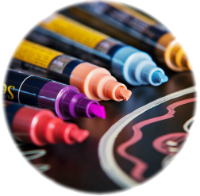
Your sign will suffer if your chalkboard pens aren't up to the job. Choosing professional pens will ensure your words are clear and vibrant. Cheap chalk markers can be filled with thin and runny ink which is impossible to use cleanly and neatly. Their pump mechanisms will also dry out or clog up easily, making it even more difficult to write clearly and consistently.
For the highest quality, you need premium chalkboard markers. Securit have been perfecting their chalkboard pen range for decades, and have a wide range of colours available. These chalk pens have dual-use reversible nibs and exceptional pump actions to produce bright and long-lasting chalk displays.
2) Choose the best pen width
Liquid chalkboard markers are available with nib sizes of 2mm, 6mm or 15mm. Each nib will draw different sized lines and should be chosen depending on the size of your chalkboard sign. Generally, a 6mm is perfect for writing smart, clear and well-defined words.
The larger 15mm chalkboard pens are fantastic for bigger titles, attention-grabbing messages or attractive borders, but you'll struggle to control them if you're writing on smaller boards. For finer details and eye-catching finishing illustrations, use a 2mm pen.
3) Prepare your chalkboard pens properly
Chalkboard markers and pens need to be prepared correctly for the best results. If you pump the nib too much, you'll soak the tip and limit the pen's accuracy. It may also drip or leak onto your blackboard. For the best results, shake the pen vertically a few times, then place the nib against paper. Press up and down until you see the liquid chalk reach the end of the tip. The moment your pen leaves a mark on the paper, stop pumping.
TIP: Securit chalkboard markers feature reversible tips, with a chisel or rounded nib. Chisel tips are fantastic for calligraphic writing and finer details, while rounded nibs are great for consistent lines, outlining and shading. Choose your nibs wisely before priming!
4) Plan your spacing

Give your layout plenty of thought before diving into writing on your chalkboard. Planning your board design and layout on a sheet of paper beforehand is a great way of creating a stunning chalkboard menu or restaurant sign.
Sketch out your design first, including any artwork. If you can fit your writing on a sheet of A4 paper with a pencil, it should be fine for your blackboard, but always remember that your chalkboard pen will be far thicker.
TIP: If you're trying to write on a footpath or pavement board, make sure you close the A frame and place it on a flat surface. This will reduce the risk of slipping while leaning on the board's surface, and also prevents the liquid chalk from running.
5) Space your chalkboard with a pencil
With your paper design finished, use a ruler and pencil to lightly trace a template onto your blackboard. Even the lightest horizontal line will help keep your writing level, and it is a great way of checking that everything fits on the board before you begin creating it.
TIP: Have you chosen a tricky chalkboard font? Tracing your individual letters in pencil, and then going over them in chalk, will produce far better results than simply 'going freehand' with your pen.
6) Choose your chalkboard pen colours carefully
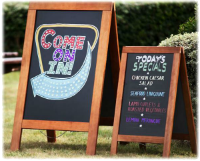
It is important to get your colour balance perfect. A splash of colour will grab the attention of your customers, but too much can be overpowering. White chalk is the easiest colour to read, while stronger colours can be used to enhance your board's design.
For a more subtle way of introducing colours to your board, consider using the pastel colours available in our chalkboard marker collection. They will help to create a more subtle and sophisticated design than brighter or more garish alternatives.
Now you've planned your chalkboard, selected your pens and primed them, you're ready to write!
7) Don't retrace your work
Liquid chalk will dry as you work, so different parts of the blackboard may appear in slightly different shades. Don't worry, this is perfectly normal. Resist the temptation to go back and retrace or go over wet chalk, as it could cause running and ruin all your hard work! Once the chalk is dry, there will be plenty of time to touch up any parts that need it. Remember to write slowly and consistently at all times.
TIP: Sometimes you will need to re-prime a chalkboard marker. Do this on a sheet of paper, well away from your blackboard.
8) Let your chalk dry properly

Most liquid chalk needs around 60 seconds to dry well enough so you can see the overall effect of your work. After this time has elapsed, you can touch up any shading, retrace parts of a word and make sure your colours are even.
NEVER write or draw over one colour of chalk with another. This will contaminate your marker's nib and ruin its colour. If you're planning to display your blackboard sign outdoors, give the chalk as long as possible to dry and become weather resistant.
9) Use both sides
If you're creating an A frame chalkboard for a footpath, pavement or walkway, make sure you use both sides. Customers will be approaching from both directions, so only marking one side of the board means half your passing trade will only see a blank blackboard. Oops!
10) Clean your chalkboard properly
You'll begin to see a milky or dusty layer appear behind the text on a blackboard that hasn't been cleaned correctly. This will dramatically reduce the impact of your bright and colourful designs. Ensure you clean it thoroughly between each use by following our simple tips below.
How to clean a chalkboard
Use a special blackboard cleaner to remove all text and drawings with a microfibre cloth, and remember to allow plenty of time for it to dry before putting it away.
Once dry, it is easier to spot any patches that aren't completely clean. If necessary, repeat the cleaning process with a fresh cloth. For the best results, chalkboard cleaners should be sprayed directly onto the board and left for around 15 seconds before applying the cloth.
TIP: Olympia chalkboards are made of melamine, which provides an uninterrupted and smooth surface that won't absorb any of the chalk. It is also easy to clean and ideal for creating visually stunning displays time and time again.
Shop all commercial blackboards