
Honing & Sharpening Chefs Knives
Ensuring that you keep your chefs knives sharpened can help in a kitchen. Not only does keeping knives sharp make your job easier to complete, but it makes your job safer. If you are using a chefs knife that isn’t kept sharp, you have to apply more pressure than you would with a sharper blade, which makes the knife more likely to slip and cause injury.
How to hone or sharpen knives with a steel
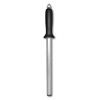
1. Place the steel tip down on a damp cloth
The damp cloth will stop slipping.
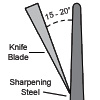
2. Place the blade at the top near the sharpening steel handle
The angle between blade and steel should be 15-20°.
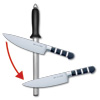
3. Pull the knife down and across the steel
The movement should be a slight arc.
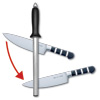
4. Repeat this action on the back of the steel
This will sharpen the other side of the blade.

5. Repeat steps three and four
Repeat five to 10 times to ensure maximum sharpness. It is very important to maintain the angle of 15-20° and to run the full length of the cutting edge along the steel from the hilt to the tip of the knife.
Knife Sharpening Options
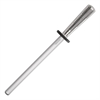
Steels
Traditional steels are suited to regularly honing knives that are already sharp to keep them in that condition. If you need to restore blunt knives use a diamond steel (industrial diamonds embedded in the blade provide a tough abrasive surface) or ceramic steels (not as abrasive as diamond - better for a finer edge).
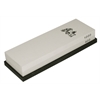
Whetstones
Whetstones are considered one of the best ways to sharpen knives. Not all whetstones require lubrication with oil or water; check the instructions for the stone you purchase.
Manual & Electric Knife Sharpeners
A hand held knife sharpener may be a good alternative to the stone or steel; the benefit being that the technique for sharpening doesn’t have to be learnt and is simpler to use.