
Choosing a Thermometer
Thermometers are available in a wide variety of styles, with something to suit all catering businesses. Buying the right thermometer is crucial, taking and recording temperature is a vital and essential part of health and safety in kitchens and restaurants. Whether you want to take the temperature of your kitchen, fridges and freezers or the food you’re making, there is a vast selection available and this guide will help you decide which is best for you.
Spirit Filled and Dial Thermometers
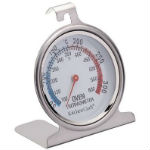
The main advantages of spirit-filled and dial thermometers is that they are generally cheaper than other varieties and they are very low maintenance as they don't have batteries to replace.
They're easy to read at a glance, but they don't give you as accurate a reading as a digital thermometer.
Most spirit filled and dial thermometers can be wall mounted, making them ideal for taking ambient room temperatures.
Digital Thermometers
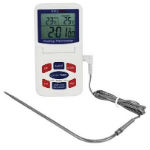
Digital thermometers are useful for a whole range of temperature taking tasks.
With fast, accurate readouts, digital thermometers are great for taking temperatures when making any number of meals. They also typically have a larger range than spirit filled or dial thermometers.
Fixed Probe Thermometers
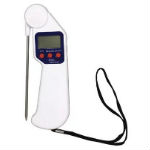
Fixed probe thermometers are very simple to use and give fast, accurate readings.
In addition fixed probe thermometers are battery powered, meaning they are infinitely portable and can be used anywhere.
There are colour coded fixed probe thermometers available, so you can use certain thermometers for specific foods.
Article: Take a look at our guide on How to Colour Code Your Kitchen to see how you can incorporate colour coded thermometers into your kitchen.
Wired Probe Thermometers
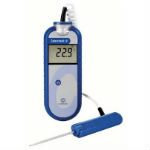
The advantage of wired probe thermometers over those with fixed probes is that wired probes can be removed and switched around depending on the type of food being cooked.
This greatly reduces cross contamination and increases hygiene in the kitchen. Wired probes also tend to come with long leads, allowing you to take temperatures from greater distances.
Considerations
When buying a thermometer there is a wide range of factors to consider, including what it’s going to be used for, where it’s going to be used, how often it’s going to be used, who is going to use it and the budget available.
Types of Thermometer
Fridge and Freezer Thermometers
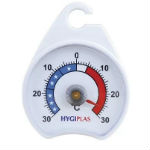
Fridge and freezer thermometers come in two basic variants. The first is a simple, traditional thermometer which hangs inside your fridge or freezer, and gives a clear, simple reading. The second, a little more advanced, features a sensor inside the fridge or freezer which is connected by a tiny wire to a screen on the outside.
Not only will this give a very accurate reading, it will also allow you to find out the temperature without opening the door, retaining the desired temperature. Another benefit is that many of them are fitted with alarms, telling you when the temperature raises or drops to an unacceptable level.
Cooking and Food Thermometers
Cooking and food thermometers are vital in any kitchen. Making sure food is served at the correct temperature is essential, regardless of what type of establishment you run.
Digital food thermometers can be slightly more expensive but they are able to take the temperature of solids and liquids, as well as ovens, the oil used in fat frying and everything from sugar to jam.
Infrared Thermometers
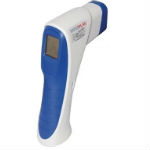
Infrared thermometers are great for avoiding cross contamination, as they will take a surface reading instantly without having to actually make contact with the food.
While they can be more expensive than other types of thermometer, they are fast, accurate, efficient and the most hygienic method.
Probe Thermometers
Probe thermometers are worth their weight in gold in any professional kitchen.
Not only will they allow you to instantly ascertain the temperature of cooked foods, liquids and semi-solids, but many models are far more hygienic than other types of thermometer thanks to the detachable probes, not to mention the wide range of cleaning products available for them.
Probe thermometers vary greatly in price, and range from simple models with basic functions to robust models with large temperature ranges and anti-bacterial casings.
Waterproof Thermometers
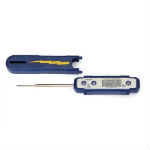
While waterproof thermometers can be used to take the temperatures of foods, they are also specially designed for use in wet environments meaning they can be used for tasks such as ensuring a dishwasher is performing correctly.
Thermometer Accessories
While Thermometer accessories include log books for recording the temperatures in your kitchen, anti-bacterial wipes, and batteries – essential for digital models.