
Choosing your Chef's Knife
It can be hard to know where to start when it comes to buying professional chefs knives, with such a wide variety of styles, brand, colours and materials available and a varied price range to match. However, the choice is actually down to what you need the knife for, and there is a knife for every job. So whether you're carving meat or delicately slicing vegetables, we have the perfect kitchen knife for your needs. The choice can also boil down to personal preference, whether you stick to a loved brand or have your trust in a forged construction. To help make the choice easier for you, we've compiled a guide to choosing the perfect knives; helping you decide which best suits your needs.
Style and Origin
When it comes to the origin and style of professional kitchen knives, it comes down to 2 main choices; European or Asian. European knives (predominantly German, Swiss and French) are generally heavier and built to withstand thicker, harder and more substantial ingredients commonly found in western cuisines, whereas Asian knives (predominantly Japanese) tend to be finer, and well suited to lighter components; great for the more intricate and detailed Asian cuisine styles.
Western style knives include: Dick, Victorinox
Knife Blades
Knife blades generally have one of two styles; a curve near the tip of the blade (cooks knives) or have a straight back from tip to bolster. As well as these differences, there are also variances when it comes to the cutting edge of the blade depending on the knives purpose - bread knives feature serrated teeth, whilst chefs knives feature a long and sharp smooth blade for slicing. Another feature to consider is whether or not the blade has indents on the side which act as air pockets to stop it from sticking to food, such as meat. There are many different types of tip styles, but knife tips have 3 main styles;
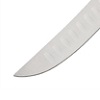
Normal or 'straight back' tips feature a straight back with a curve upwards, commonly seen on heavy duty knives
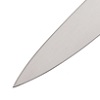
Drop point blades feature a convex curve of the back towards the tip, almost like a sword, making it more suited to piercing
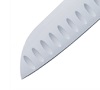
And the sheepsfoot blade, mostly seen on Asian style knives which have a completely straight blade edge with the back curving down towards the tip, great for chopping vegetables
Other chef knives such as paring and filleting knives have more distinguishable tip designs that make them more adequately suited to the task they're design for.
Serrated vs Smooth Blade
The cutting edge of a serrated blade has many small points of contact with the food being cut, which means less contact area than a smooth blade. The applied pressure at each point of contact is relatively greater and the points of contact are at a sharper angle to the material being cut, helping the blade to slice through items that are firm on the outside and soft on the inside, particularly bread or tomatoes. Serrated blades tend to stay sharper longer than a straight edged blade but they are difficult to sharpen. Serrated blades are less suitable for delicate items; so small, smooth edge blades are better.
Knife Construction
Chef knives are made in two ways; a forged construction or a stamped construction.
Stamped knives are cut to shape from cold-rolled steel, heat treated for added strength, sharpened and then polished. Stamped knives are considered to be of a lower quality to forged knives, but some of the world's best premium knives feature a stamped construction.
Forged knives are made by a very intricate, complex and multi-step process. Often made by hand, forged knives are of the highest quality; a chunk of powdered or solid steel alloy is heated until it glows white hot and is then hammered to form its shape, much like medieval blacksmithing. The blade is then heated above critical temperature, quenched and tempered to the desired hardness. After forging and heat-treating, the blade is polished and sharpened. Forged blades are typically thicker and heavier than stamped blades.
Types of Knives
Chefs Knife
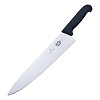
The chefs knife, also known as the cooks knife, is the go-to knife for many chefs. Generally much longer and heavier than other knives, it is an extremely versatile knife. Chefs often spend the most money and time when buying their cook's knife.
Choppers and Cleavers
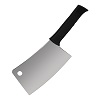
The biggest of the chef knives, choppers and cleavers feature a large rectangular blade and are designed for chopping thick slabs of meat or bone with ease, but can also be used to make light work of large vegetables. A large handle will provide you with good leverage for a stronger chopping action, whilst also ensuring your hands are well clear of any danger.
Fillet Knife
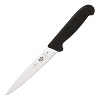
Featuring a long and flexible blade, fillet knives are ideal for reaching parts of meat that are difficult with a large cook's knife. Fillet knifes, so appropriately named, are perfect for filleting fish as they can glides past the small bones to get at all the flesh possible. Their delicate and flexible design makes them unsuitable for chopping.
Boning Knife
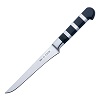
Boning knives feature a stiff blade that makes them well designed for removing meat from bones. They can be used with an underhand and overhand grip, often used by butchers when jointing hanging cuts.
Bread Knife
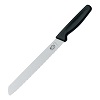
Bread knives have a sharp serrated blade that easily cuts through tough bread crusts and usually feature a long blade for carving.
Tomato Knife
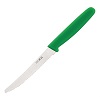
Tomato Knives are similar to bread knives but have a shorter blade, making them perfect for creating thin slices of tomato without squishing or crushing them. Many tomato knives also feature a pointed or forked end to help you to pick up the sliced fruit.
Paring Knife
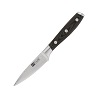
Paring knives are small versions of cooks knives, allowing you to carry out general slicing, chopping and mincing but their smaller sizes makes them ideal for doing more intricate work.
Utility Knife
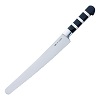
Designed for 'general' food prep, utility knives are between paring knives and cooks knives in size and allow you to cut, slice, chop and mince.
Santoku Knife
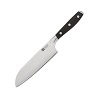
Santoku knives originate from Japan and feature a sheepsfoot tip design with an angle approaching 60 degrees at the tip. Designed for slicing, dicing and mincing and featuring a blade and handle that are almost perfectly balanced, these knives are extremely easy to use.
Turning Knife
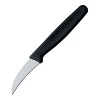
Perfect for creating Chateau potatoes, the turning knife is also ideal for shaping, peeling and trimming all types of fruit and vegetables. The curved blade helps to make light work when peeling and is often referred to as 'the beak'.
Knife Sharpeners
Honing and sharpening your knife is very important as it keeps it performing as well as it should, but it also protects you from potential accidents. A blunt knife makes it hard to cut food, whereas a sharp knife does all the hard work for you and glides through food.
Take a look at the knife sharpeners we have: