
BUYING CROCKERY
When it comes to buying crockery for an eatery, it may not be the most expensive item on the list to buy, but it is one of the most important. People will judge a business on its crockery, so the chosen crockery has to stand the test of time by still looking new each time it’s placed on a table with a meal presented on it. However, what’s the best way to decide which crockery is the one to create the right impression?
HAVE A CLEAR BUDGET
Firstly, any business needs to do their sums and work out how many plates are needed for example. From there, see if there is any bulk buy options available and how many of the chosen plate is in each box. Have a clear idea of what the budget is; it’s no good choosing a brand if the price is more than the budget.
STORAGE OF CROCKERY
When choosing crockery, think practically. How much storage space is available for the crockery and what size items are actually needed? Is there enough space for the chosen plate sizes and enough room to safely store the various styles of cups and mugs?
QUANTITY OF CROCKERY
How many of each different item is needed? If we look at plates again; will the starters be served on different plates from the mains? And of course desserts aren’t going to come out on the same size plate as any mains. Factor in the cost for the various sizes to ensure that the set budget is in fact correct; with products coming in a variety of shapes and sizes; there are many factors to consider for the money.
One of the most important issues to factor in is whether the product is dishwasher safe. With a busy kitchen to run, there needs to be a quick turnaround on the meals, so ensure there is enough crockery to cater for the customer’s demands to save any unnecessary holdups.
COLOUR OF CROCKERY
Although white is the automatic choice for crockery, it doesn’t have to be the only choice if a splash of colour is wanted on the table; whether it’s a black plate, a blue latte mug, an orange cappuccino cup or a patterned saucer; the options really are endless. Colour can be very important to people to make sure that the crockery matches all the different pieces of tableware.
Ensuring that the choice of crockery has an even glaze is always important. Most items such as plates are finished with a glossy finish, although matt glazes are also available from some manufactures. Colours can also be added to the glaze.
The most important factor is that the crockery should ‘frame’ the food, not detract from it.
Types of Crockery
There are also different types of crockery available; remember each will have its own positives and negatives which is why research before purchasing is always a wise move.
Bone China
Bone China is a type of soft-paste porcelain that is composed of ash from animal bones, felspathic material and kaolin. It is known for its high levels of whiteness and translucency and for its very high mechanical strength and chip resistance. Bone China is a cost effective choice and comes in many colours and patterns. As it is strong, manufacturers can make it very thin; this gives it the benefit of being a lot lighter than other ceramic pieces. To be called ‘fine bone china’, it must be made of more than 45 percent bone ash.
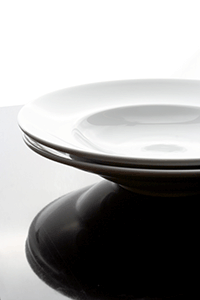
Porcelain
Porcelain is a ceramic material made by heating raw materials, generally including clay in the form of kaolin, in a kiln to temperatures between 1,200 °C and 1,400 °C. The toughness, strength, and translucence of porcelain arise mainly from the formation of glass and the mineral mullite within the fired body at these high temperatures. Porcelain crockery differs in the price range; while some can come cheap, some is expensive. Porcelain derives its present name from old Italian porcellana (Cowrie shell) because of its resemblance to the translucent surface of the sea snails shell. Porcelain has good resistance to ‘thermal shock’, which is why it is often used as oven to tableware.
Earthenware
Earthenware is a white and porous clay that is fired at a low temperature; it is one of the oldest materials used in pottery. Earthenware usually called 'ceramics' or 'ceramic ware', is decorated, glazed with a clear coat and fired. Although considered cost-effective, it is not as tough or water-resistant as other ceramics. Earthenware has to be glazed or it will absorb water, making the cleaning process difficult. Some earthenware are vitrified; this is when a ceramic body is fired to a temperature of above 1210°C; the body of the material melts together. This means the material becomes non porous so neither water nor bacteria can seep in.
Stoneware
Stoneware is chip-resident and used for many uses within the kitchen including the refrigerator, oven and microwave. Stoneware is a stronger clay that is fired to a high temperature (about 1200°C) and becomes vitreous. Although it is more waterproof than earthenware it should also be glazed for better performance. It is known for being strong and durable, making it a perfect for daily use crockery.
Alumina
Alumina enriched is crockery that contains the material alumina. Crockery made from this product can normally be spotted due to its creamy colour. Alumina is an oxide of aluminium, which is added to the clay to give it additional strength. This is more expensive than standard porcelain, though it is generally cheaper than bone china.
Melamine
Melamine crockery is a strong, lightweight and hard thermosetting plastic. Melamine is used as an ideal hygienic and durable alternative to china as it is virtually unbreakable to meet the tough demands of everyday use. As well as being virtually unbreakable, it resists scratching and staining, is heat resistant and dishwasher safe.
Kiln
Looking to add a unique style to your table service? Olympia Kiln is designed to help your restaurant stand out from the competition, boasting distinctive, eye-catching designs that perfectly complement any dish. Kiln helps you to frame your food, making it look as good as it tastes. Visit our Olympia Kiln page to transform your table service today.